

Home > News > Industry news > Autonomous Drones: New Challenges for Jamming Technology


The landscape of modern warfare, security, and commercial airspace is being fundamentally reshaped by the proliferation of drones. However, the latest evolution—the shift from remotely piloted aircraft to fully autonomous drones—is creating a significant technological arms race. As these unmanned systems gain the ability to operate without human intervention or real-time communication links, traditional jamming technology is rapidly becoming obsolete.
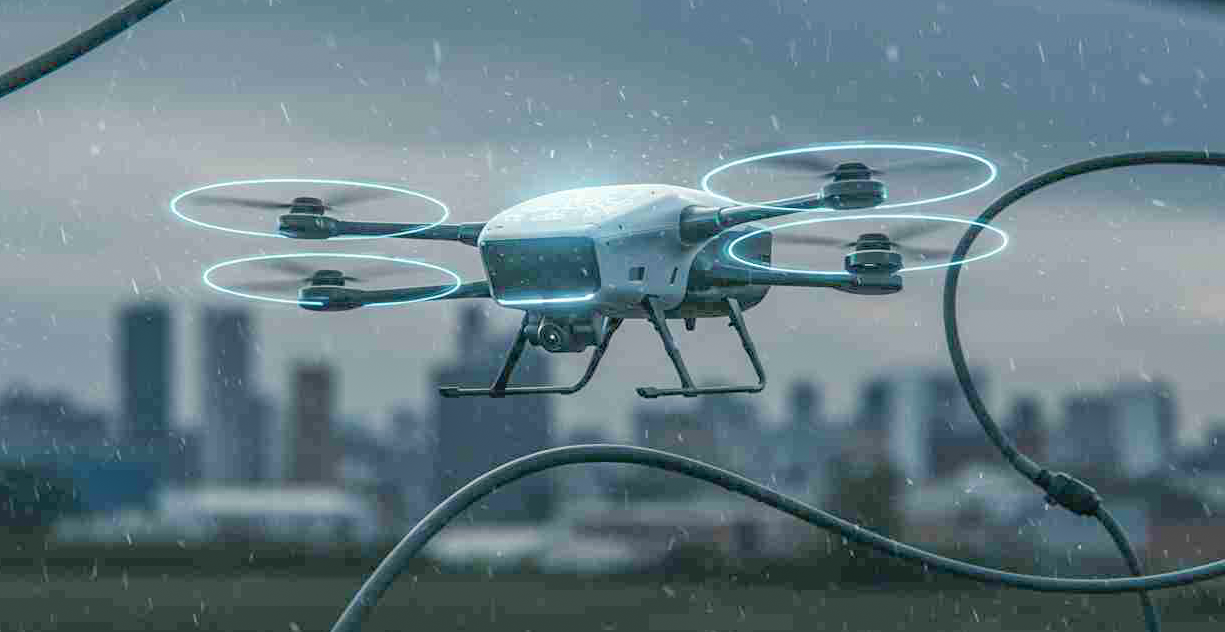
For decades, electronic warfare (EW) strategies relied on a simple premise: break the link between the operator and the aircraft. By flooding radio frequencies (RF) with noise, systems could effectively “blind” a drone, forcing it to land, return home, or fall from the sky. But what happens when there is no link to break?
Modern autonomous drones no longer rely on a constant “man-in-the-loop” command structure. Instead, they utilize advanced sensors, onboard artificial intelligence (AI), and pre-programmed mission parameters to navigate, identify targets, and execute objectives.
This autonomy presents a fundamental problem for traditional counter-unmanned aircraft systems (C-UAS). If a drone utilizes AI-based navigation—such as visual odometry or terrain mapping—it can continue its mission with pinpoint accuracy even if the GPS signal is jammed and all radio communications are cut off.
To understand the new challenges, one must first recognize the limitations of current jamming technology:
RF Jamming Inefficacy: Autonomous drones often fly on “set and forget” missions. Once launched, they ignore incoming commands. Jamming the control link has no effect because the drone is not listening for commands; it is executing its own logic.
GPS Denial Tolerance: High-end autonomous platforms are equipped with Inertial Navigation Systems (INS) and visual odometry. They can cross-reference landmarks with pre-loaded 3D maps to determine their location within centimeters, rendering GPS spoofing or jamming ineffective.
Frequency Agility: Many next-generation autonomous drones utilize AI-driven adaptive frequency hopping, making it difficult for traditional wideband jammers to maintain a lock on the signal long enough to disrupt it.
In response to these threats, a new generation of cognitive electronic warfare systems is emerging. Unlike traditional jammers that emit constant noise, modern jamming technology is leveraging machine learning to adapt in real-time.
Instead of destroying the drone, new strategies focus on manipulating the autonomous decision-making process. This involves “spoofing” the sensor inputs that the AI relies on. For example, by emitting false LIDAR or radar signals, counter-drone systems can trick an autonomous drone into perceiving an obstacle that isn’t there, forcing it to reroute or hover indefinitely.
One of the most daunting threats is the drone swarm. A swarm of 100 autonomous drones cannot be stopped by traditional kinetic weapons or single-target jammers. New jamming technologies are being designed to inject corrupted data into the swarm’s mesh network. By exploiting the swarm’s reliance on inter-drone communication, jammers can cause the group to fracture, collide, or revert to safe modes, effectively neutralizing the swarm through algorithmic confusion.
The hardware used for jamming is also evolving. Fixed-frequency jammers are being replaced by Active Electronically Scanned Arrays (AESAs) . These allow for beamforming—focusing concentrated energy on a specific drone or group of drones without disrupting surrounding civilian communications.
Furthermore, High-Power Microwave (HPM) systems are emerging as the ultimate counter to autonomy. Unlike jamming, which relies on data corruption, HPM systems physically fry the microelectronics inside the drone. Since autonomous drones rely heavily on onboard computing power (GPUs and CPUs) to run AI models, they are particularly vulnerable to electromagnetic pulses that destroy these delicate circuits.
As jamming technology becomes more aggressive, new regulatory hurdles emerge. In civilian airspace, the use of traditional RF jammers is illegal in most jurisdictions due to the risk of disrupting emergency services and aviation.
However, the threat of rogue autonomous drones is forcing regulators to reconsider “layered defense.” The future likely holds a blend of cyber takeover (hacking the AI) and directed energy (physically disabling the hardware), but only if legal frameworks can adapt as fast as the technology does.
The era of the simple radio-controlled drone is ending. As artificial intelligence takes the pilot’s seat, jamming technology must undergo a radical transformation. The future of counter-drone defense lies not in breaking communication links, but in corrupting sensor inputs, disrupting swarm algorithms, and utilizing high-powered microwaves to neutralize onboard electronics.
For defense contractors and security professionals, the race is no longer about who has the strongest signal, but who has the smarter AI.
Disclaimer: This article discusses electronic warfare concepts for informational and academic purposes. The use of jamming equipment is strictly regulated and subject to local and international laws.
86-13920737097
AddNo. 15, Rongyuan Road, Huayuan Industrial Park, Binhai Hi-tech Zone, Tianjin, China.
E-mailjackyjingtj@gmail.com
Copyright @ 2026 BNT PTE. LTD. No:84463
Copyright @ 2026 BNT PTE. LTD.
Copyright @ 2026BNT PTE. LTD.


