

Home > News > Industry news > Anti-Drone RF Power Amplifier Modules Explained


The rapid proliferation of commercial drones has created a parallel demand for robust Counter-Unmanned Aircraft Systems (C-UAS). While radar and cameras serve as the “eyes” of drone defense, the Radio Frequency (RF) Power Amplifier (PA) module serves as the “muscle.” Whether the goal is to force a drone to land, return to home, or simply block a video downlink, the RF PA is the critical final stage that transforms a calculated signal into a powerful electromagnetic barrier. Understanding the specifications and technology behind these modules is essential for anyone integrating modern anti-drone solutions.
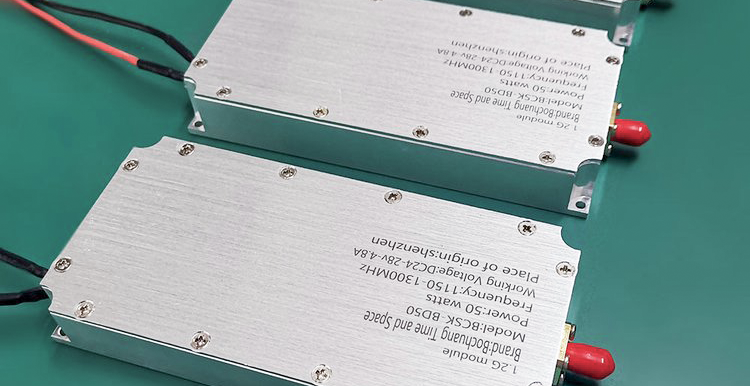
In the simplest terms, an RF power amplifier module is an electronic circuit that boosts a low-power RF input signal—generated by a signal generator or Software-Defined Radio (SDR)—to a high-power output suitable for transmission through an antenna. In the context of C-UAS, this output is not communication; it is electronic attack or jamming.
Unlike communication amplifiers that prioritize linearity for data integrity, anti-drone amplifiers prioritize raw output power (often measured in watts or kilowatts) and wide bandwidth to cover multiple threat vectors simultaneously. They are specifically designed to operate within the ISM bands most commonly used by drones: 2.4 GHz, 5.8 GHz, and GNSS bands (GPS L1/L2).
To effectively neutralize a drone, the RF PA module must overcome the link budget between the drone and its pilot or satellite. There are three primary target frequency ranges for these modules:
2.4 GHz & 5.8 GHz ISM Bands: These are the primary command and control (C2) and video transmission links. A high-power amplifier in this range saturates the receiver on the drone, causing a loss of video feed or control lock.
GNSS Bands (1.1 – 1.6 GHz): By amplifying noise or spoofing signals in the GPS and GLONASS bands, the PA helps deny the drone positional awareness, often triggering a fail-safe landing or hover.
Most modern anti-drone PA modules are broadband, meaning a single module can cover 1 GHz to 6 GHz in one sweep. This is achieved using advanced semiconductor materials like Gallium Nitride (GaN) .
A decade ago, anti-drone PAs relied heavily on Gallium Arsenide (GaAs) or LDMOS silicon. Today, GaN-on-SiC (Gallium Nitride on Silicon Carbide) dominates the high-power C-UAS market. Here’s why it matters for drone defense:
High Power Density: GaN amplifiers can output significantly more power in a smaller physical footprint. This allows for man-portable or vehicle-mounted jammers without massive cooling systems.
Thermal Efficiency: Drone jamming is often continuous wave (CW) or high duty cycle. GaN handles the extreme heat generated during sustained jamming bursts much better than legacy technologies.
Wide Bandwidth: GaN transistors can efficiently amplify signals across multiple octaves, allowing a single module to cover GPS, Wi-Fi 2.4G, and Wi-Fi 5.8G without switching hardware.
When evaluating an RF PA module for anti-drone applications, looking beyond just “Watts” is crucial. Here are the specs that dictate real-world performance:
P1dB (1dB Compression Point): This defines the linear limit of the amplifier. For jamming complex modulated signals like OFDM (used in DJI drones), operating slightly below or at P1dB ensures the jamming waveform isn’t distorted before it even hits the antenna.
Gain (dB): This determines how much input drive is required. A high-gain module (e.g., 50dB) can be driven by a low-cost SDR; a low-gain module requires a more expensive driver amplifier.
Harmonic Suppression: Jamming is a brute-force technique, but it must be legally compliant. High-quality modules include integrated filtering to ensure that harmonics (e.g., signals bleeding into aviation or emergency bands) are suppressed by at least -50dBc.
VSWR Protection: Antennas in the field get damaged or disconnected. A rugged anti-drone PA must withstand high Voltage Standing Wave Ratio (VSWR) conditions (open/short circuits) without self-destructing.
An RF power amplifier module is not a standalone weapon. It sits at the end of a signal chain. A typical integration looks like this:
Digital Threat Library / SDR -> Waveform Generator -> Driver Amplifier -> **High-Power GaN PA Module** -> Directional/Omni Antenna
The module requires a substantial DC power supply—often 28V or 50V at high current—and an advanced thermal management solution (heatsinks and forced air or liquid cooling). Modern modules also include RF sample ports for built-in test equipment (BITE), allowing the system to verify output power and VSWR health in real-time.
The next generation of RF PA modules is moving toward Digital Pre-Distortion (DPD) integration. As drone signals become more frequency-hopping and encrypted, simple broadband noise is less effective. Smart jamming requires clean, powerful, targeted waveforms. DPD linearizes the amplifier, allowing it to transmit “smart jamming” protocols at peak efficiency.
In conclusion, the anti-drone RF power amplifier module is the cornerstone of electronic warfare at the tactical edge. The shift toward GaN semiconductor technology is enabling lighter, more efficient, and more lethal C-UAS platforms capable of keeping pace with the ever-evolving drone threat landscape. When selecting a module, prioritizing ruggedness, bandwidth, and thermal design is just as critical as the raw wattage on the datasheet.
86-13920737097
AddNo. 15, Rongyuan Road, Huayuan Industrial Park, Binhai Hi-tech Zone, Tianjin, China.
E-mailjackyjingtj@gmail.com
Copyright @ 2026 BNT PTE. LTD. No:84463
Copyright @ 2026 BNT PTE. LTD.
Copyright @ 2026BNT PTE. LTD.


